


Consignment Auctions vs. Gun Stores: The Best Way to Sell Your Firearm Collection

Updated: Jul 21
Published by the Gun Auctions USA Team | Reviewed and Verified for FFL Regulatory Compliance by FFL Owner / Auctioneer: Star Drouse

If you find yourself in a garage, spare room, or estate property staring at a firearm collection that needs to be sold, the choice between a consignment auction and a gun store is significant. This decision directly impacts how much money you recover, how much work you take on, and how safely and legally the transaction is handled. For many sellers in Florida, especially heirs, trustees, and collectors, the choice often boils down to one question: do you want a fast wholesale offer, or do you want the market to compete for your guns?
A gun store and a consignment auction serve two very different purposes. A store is designed to buy low enough to resell at a profit. An auction, on the other hand, exposes the inventory to as many qualified bidders as possible, allowing demand to set the price. Both options have their merits. The right choice depends on the collection, your timeline, and how much value you are willing to leave on the table in exchange for speed.
Consignment Auction vs. Gun Store: Understanding the Real Difference
The biggest difference is not just where the guns are sold; it’s how value is created.
When you walk into a gun store with firearms to sell, the store typically makes a direct purchase offer. This offer must account for overhead, time on the shelf, market risk, and resale margin. Even a fair and honest dealer is buying as a reseller, not as an end user. This means the number you hear is often based on wholesale logic.
In contrast, a consignment auction operates from the opposite direction. Instead of one buyer naming one price, multiple buyers compete. Rare firearms, desirable modern handguns, military pieces, collectible shotguns, high-condition revolvers, NFA-related accessories where lawful, optics, ammunition, and estate groupings can all attract varying levels of demand. The more exposure the items receive, the more accurate the final market result tends to be.
This is why sellers comparing consignment auctions to gun stores often realize they are not comparing two versions of the same service. They are comparing liquidation at dealer pricing versus sale at open-market pricing.
When a Gun Store Makes Sense
A local gun store can be the right choice in certain situations. If speed matters more than return, a store is often the quickest route from inventory to cash. You bring in the guns, the dealer inspects them, and if there is interest, you may receive an offer that same day.
This convenience is crucial when the collection is small, the firearms are common, or the seller simply wants the matter resolved immediately. Some sellers prefer a face-to-face local transaction because it feels familiar. If you have one or two mainstream firearms in average used condition and you do not want to wait for an auction cycle, a store may be a practical option.
However, there is a trade-off. The dealer must leave room for negotiation, hold time, and profit. If a pistol is likely to retail for $600, the store cannot usually pay you $600. The same logic applies across rifles, shotguns, and accessories. The easier the transaction becomes for the seller, the more likely the price reflects a wholesale discount.
This discount can become significant when the collection includes better pieces, larger quantities, or estate firearms that the seller has not fully researched. Inherited collections are especially vulnerable to underpricing because heirs often do not know which items are routine and which are premium.
Why Consignment Auctions Often Bring Stronger Returns
A properly run firearm auction is designed to create competition. That may sound simple, but execution matters.
Professional consignment auction firms do more than post a few photos and wait. They research values, write accurate catalog descriptions, photograph each lot at scale, market to active bidders, manage bidder registration, collect payments, coordinate shipping, and handle legal transfer requirements for modern firearms. This full-service structure transforms a pile of inventory into a sale event.
The strongest advantage is reach. A local store primarily relies on local foot traffic and its regular customer base. An auction can showcase a Colt revolver to collectors in multiple states, a hunting rifle to seasonal buyers, and an estate grouping to bidders who specialize in that niche. More qualified eyes usually mean more bidding pressure.
This is where a multi-platform approach can outperform a single sales channel. Gun Auctions USA, for example, employs a Triple Auction System that places inventory in front of bidders across HiBid, Proxibid, and LiveAuctioneers. This kind of exposure is not just a marketing detail; it is a price-driving mechanism. More bidder competition leads to stronger hammer prices.
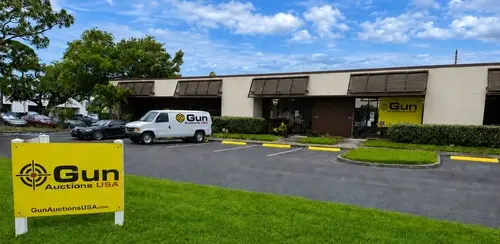
GUN AUCTIONS USA
10550 72nd St. STE 505
Largo, FL 33777
Call 888-659-9909 with any questions you may have:
The Legal Side: A Critical Component
With firearms, compliance is not optional; it is part of the value of the service.
Many sellers underestimate how much legal handling matters until they face a transfer question, an estate issue, or a shipping problem. A reputable gun store may handle standard purchases properly, but estate liquidations and larger consignments often require more process, more documentation discipline, and more administrative control.
A specialized firearm auction company is built for that complexity. This includes intake procedures, catalog tracking, transfer protocols, background checks for modern firearms, and coordination with receiving dealers where required. For estates and inherited collections, this level of structure is essential because the seller is often not a gun expert and does not want to guess through the process.
A compliant auction operation also mitigates another common risk: selling the wrong item the wrong way for the wrong price because no one did the work upfront. Proper identification and handling protect both value and liability.
Seller Effort: What Ends Up on Your Plate
On paper, selling to a gun store appears easier. In reality, it depends on the quality of the service.
If you are managing an estate with dozens or hundreds of firearms, plus ammunition, magazines, scopes, and related accessories, the transaction is not simple, regardless of where it goes. Inventory must be reviewed, sorted, moved, documented, and priced. If you attempt to shop a large collection around to local stores, you may spend a great deal of time receiving inconsistent offers from buyers with varying interests.
A full-service consignment auction can alleviate that burden. Instead of the seller managing valuation, photography, marketing, and buyer communication, the auction firm takes over the operational load. This is particularly valuable for families clearing a home, fiduciaries working under deadlines, and heirs who need a clean, defensible liquidation path.
This is one of the most overlooked aspects of the consignment auction versus gun store decision. It is not only about sale price; it is also about how much uncertainty, labor, and risk you retain versus hand off.
The Timeline Question
Let’s be clear: auctions are not always faster. They often take more time.
If you need immediate payment today, a direct store sale will usually move faster than a consignment cycle. Auctions require intake, lotting, photography, cataloging, marketing, bidding, settlement, and final disbursement. This process takes time because it does more work upfront to improve the result on the back end.
For many sellers, that extra time is worth it. If the collection has significant value, waiting for a professionally marketed auction often yields a stronger net outcome. However, if the estate is under pressure, the property must be vacated immediately, or cash is needed right away, speed may win.
That is why the best answer often depends on the collection itself. One common hunting rifle may not justify a lengthy strategy discussion. A 75-gun estate, a collector accumulation, or a mixed lot with vintage and premium firearms absolutely does.
Sellers Who Should Think Twice Before Taking the Store Offer
If you are an heir, executor, trustee, or family member managing an inherited collection, be cautious about defaulting to the quickest bid. Estates often contain uneven value. Ten guns may be ordinary, three may be desirable, and one may be the piece that changes the entire recovery number.
Collectors should also be wary. Better-condition firearms, discontinued models, historical pieces, branded accessories, and category-specific demand do not always appear in a basic counter offer. A store may still make a reasonable proposal, but reasonable for a reseller is not the same as optimal for the owner.
Sellers with larger groups should pay attention to logistics. As volume increases, the issue becomes more than price per firearm; it becomes a project. This is where a specialized auction team typically distinguishes itself from a general local buyer.
The Best Choice Depends on Your Priorities
If your top priority is immediate convenience and you accept dealer-level pricing, a gun store can be a workable solution. If your priority is maximizing return, creating buyer competition, and handing the legal and operational workload to specialists, consignment is usually the stronger path.
The clearest way to think about the consignment auction versus gun store is this: a store buys for resale, while an auction sells to the market. One is built around inventory acquisition; the other is built around price discovery.
For firearm owners in Florida, especially families dealing with estates and inherited collections, this distinction matters more than ever. The right selling method should protect value, reduce legal risk, and eliminate guesswork at a time when there is already enough to manage. Before you accept the first offer across the counter, ensure you know whether you are choosing speed or sacrificing the chance to let the market do its job.
Ultimately, deciding between a consignment auction vs. gun store comes down to whether you prioritize a quick lump-sum buyout or getting true market value for every firearm.
Bid with absolute confidence. Gun Auctions USA / GAU Firearms LLC is a fully regulated FFL dealer processing thousands of firearms through *HiBid, Proxibid, and LiveAuctioneers with a verified 5-star reputation. Click here to read our client reviews on LiveAuctioneers.


Comments