


Inheriting
NFA Firearms
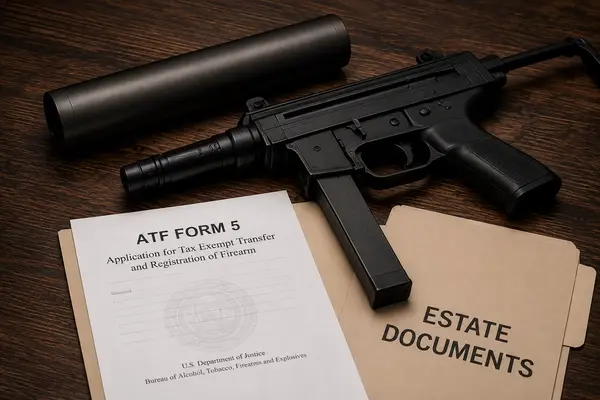
Special federal rules apply when an estate includes a suppressor, machine gun, short-barreled firearm, or other firearm regulated under the National Firearms Act.
Executors, trustees, heirs, and families should identify these items early and follow the proper ATF transfer process before distributing or selling them. Federal regulations contain specific procedures for NFA firearms held in a decedent’s estate.
⚠️ IMPORTANT: Gun Auctions USA does not provide legal advice. This page is provided for general informational and educational purposes only and is not legal advice. National Firearms Act firearms are subject to federal registration, possession, transfer, transportation, and estate-administration requirements, and additional state or local laws may also apply.
What Are NFA Firearms?
The National Firearms Act regulates specific categories of firearms and devices under federal law. NFA firearms are registered in the National Firearms Registration and Transfer Record, and their transfer generally requires ATF approval.
Suppressors
Suppressors, sometimes called silencers, are regulated under the NFA and should not be treated like an ordinary firearm accessory when found in an estate.
Machine Guns
Machine guns are regulated under the NFA and are subject to additional federal restrictions. Their registration and transfer status should be confirmed before any estate disposition.
Short-Barreled Rifles and Short-Barreled Shotguns
Certain rifles and shotguns with barrels or overall dimensions falling within NFA definitions are federally regulated and require the appropriate registration and transfer process.
Other NFA Firearms
The NFA also covers certain destructive devices and firearms classified as “any other weapon.” If an item’s classification is uncertain, do not assume it can be distributed as an ordinary firearm.
⚠️ Get Professional Help if Needed
Consult an FFL or Attorney when rules are unclear.
What Should an Executor Do First With an NFA Firearm?
The executor’s first job is not to sell or distribute the item. It is to secure it, identify it, locate the existing registration information, and determine the correct transfer path.
Secure the Firearm
Keep the firearm under the control of the estate and prevent unauthorized access. Do not casually give it to a beneficiary, family member, or prospective buyer.
Locate Existing NFA Paperwork
Search the decedent’s records for approved ATF forms, tax stamps, trust documents, firearm records, serial numbers, and other paperwork associated with the item.
Confirm Who Is Administering the Estate
The person filing the estate transfer paperwork should have authority to act for the estate as executor, administrator, personal representative, or other authorized fiduciary. For a detailed explanation of estate authority, see Can an Executor Sell Estate Firearms in Florida?
Identify the Intended Recipient
Determine whether the NFA firearm will pass to a beneficiary of the estate or be sold or otherwise transferred outside the estate. Those paths are treated differently under federal regulations.
How Does an NFA Estate Transfer Work?
Federal regulations provide a specific procedure for transferring registered NFA firearms from a decedent’s estate. The required form and tax treatment depend on who will receive the firearm.
Transfer to an Estate Beneficiary
When a registered NFA firearm is being transferred to a beneficiary of the estate, the executor generally files ATF Form 5 (5320.5) to register the firearm to the beneficiary. The transfer can qualify for tax-exempt treatment.
ATF Approval Comes Before Distribution
The firearm should not be distributed to the beneficiary until ATF approves the transfer. ATF’s NFA guidance specifically instructs executors to obtain approval before delivering the firearm to the lawful heir.
Transfer Outside the Estate
If there is no beneficiary who will receive the firearm, or the beneficiaries do not wish to possess it, federal regulations provide for disposition outside the estate using the appropriate transfer process. Section 479.90a identifies ATF Form 4 for a transfer to a non-beneficiary.
⚠️ Do Not Wait Until Probate Has Closed
Current federal regulations state that the executor must submit the appropriate transfer application no later than the close of probate.
What Is ATF Form 5?
ATF Form 5 is the federal application used for certain tax-exempt transfers and registrations of NFA firearms. One of its specifically recognized uses is transferring an NFA firearm from an estate to a beneficiary
Who Files Form 5?
In an estate transfer, the executor or other authorized estate representative files the application on behalf of the estate.
The Estate Is the Transferor
Federal regulations direct the executor to identify the estate as the transferor when an NFA firearm is being registered to a beneficiary.
The Beneficiary Is the Transferee
The person who will inherit the firearm is identified as the transferee and must satisfy the applicable federal requirements.
Supporting Documentation May Be Required
The application should include the information and supporting documentation required by the current Form 5 instructions. Always use the current ATF form and instructions rather than relying on an old saved copy.
Can an Out-of-State Heir Inherit an NFA Firearm?
An heir living outside Florida may still be able to receive an NFA firearm, but the NFA transfer process and the laws of the heir’s state must be considered. For broader interstate transfer and shipping rules, see Interstate Gun Sales, Transfers & Shipping.
Federal Estate Transfer Rules Still Apply
The executor should follow the federal estate-transfer process and obtain ATF approval before the firearm is distributed.
The Firearm Must Be Legal for the Heir to Possess
ATF approval under federal law does not eliminate any restrictions that apply under the law of the state where the beneficiary will possess the firearm.
Interstate Movement May Require Additional Review
Some NFA firearms are subject to additional federal rules concerning interstate transportation. The executor or beneficiary should determine whether any separate approval is required before moving the firearm across state lines.
What if the Estate Wants to Sell the NFA Firearm?
An executor may decide that an NFA firearm should be sold rather than distributed to a beneficiary. That is a different transaction from a tax-exempt estate-to-beneficiary transfer. For professional evaluation and auction options, see Estate Gun Consignment.
Sale to a Non-Beneficiary
Federal regulations provide that when an estate firearm is transferred outside the estate to a non-beneficiary, the executor uses the applicable transfer procedure rather than the estate-beneficiary Form 5 path. Section 479.90a identifies ATF Form 4 for this circumstance.
Do Not Transfer Possession Before Approval
A prospective purchaser should not take possession of the NFA firearm merely because the estate has agreed to sell it. The required federal transfer approval must occur first.
Market Value Can Matter
Some transferable machine guns and other NFA firearms can represent significant estate assets. Executors should consider professional identification and valuation before deciding how the item should be sold.
What if You Cannot Find the NFA Registration Paperwork?
Missing paperwork does not automatically tell you whether an NFA firearm is legally registered. Families should not guess about registration status based solely on whether a tax stamp or copy of an ATF form can be found.
Do Not Sell or Distribute the Firearm
Keep the item secure and do not transfer it to a beneficiary, buyer, dealer, or other person until the registration and lawful disposition path have been reviewed.
Preserve All Available Records
Keep the decedent’s estate files, trust records, firearm receipts, serial-number information, photographs, correspondence, and any partial ATF documentation.
Contact Appropriate Professional Help
Registration questions involving an estate can require communication with ATF’s NFA Division and may also warrant advice from an attorney experienced with NFA and estate matters.
Executor Checklist for NFA Firearms
1. Secure the Item
Prevent unauthorized access and unnecessary movement.
2. Identify the NFA Firearm
Record the manufacturer, model, caliber, serial number, and apparent NFA classification.
3. Locate Registration and Estate Documents
Gather ATF forms, tax stamps, trust records, the will, letters of administration, and other relevant documents. For broader estate-firearm guidance, see the Florida Inherited Gun Laws & Estate Guide.
4. Determine the Intended Recipient
Confirm whether the item will go to a beneficiary or be transferred outside the estate.
5. File the Appropriate ATF Transfer Application
Use the current ATF procedure applicable to the intended transfer.
6. Wait for Approval Before Distribution
Do not deliver the firearm to the beneficiary or purchaser until the required federal approval has been received.

Need Help With NFA Firearms in an Estate?
Gun Auctions USA can assist with firearm identification, valuation, and estate-consignment planning, while regulated firearm handling is coordinated through our affiliated FFL. Legal or NFA-specific questions should be reviewed with qualified counsel or the appropriate federal authority.
-
Confidential & Professional
-
Over 40,000 Firearms Sold Since 2017
-
FFL-Compliant Firearm Handling
-
Nationwide Auction Exposure - The Smart Way to Sell
or call 727-392-3950
Frequently Asked Questions About Inheriting NFA Firearms
Can I inherit a suppressor?
Potentially, yes. A registered suppressor may be transferred from an estate to a qualifying beneficiary through the applicable NFA estate process. ATF Form 5 is used for qualifying tax-exempt estate-to-beneficiary transfers, and approval should be obtained before the suppressor is distributed.
Can I inherit a machine gun?
Potentially, if the firearm is lawfully registered and the proposed transfer is lawful. Machine guns are subject to additional federal restrictions, so the executor should verify the firearm’s status and obtain the appropriate ATF approval before distribution.
Can an executor give an NFA firearm to an heir before Form 5 is approved?
No. ATF guidance states that the transfer application should be approved before the NFA firearm is distributed to the lawful heir.
Is Form 5 always tax-exempt for an estate transfer?
Form 5 is used for qualifying tax-exempt transfers resulting from operation of law, including an estate transfer to a beneficiary. A sale or other transfer to someone outside the estate may require a different process, including Form 4.
Can an out-of-state heir inherit an NFA firearm?
Possibly. The federal NFA estate-transfer process can still apply, but the beneficiary must be legally eligible to possess the firearm, and the law of the beneficiary’s state must also permit possession. See Interstate Gun Sales, Transfers & Shipping for the broader interstate rules.
What happens if no beneficiary wants the NFA firearm?
Federal regulations provide for the executor to transfer the firearm outside the estate using the appropriate procedure. Section 479.90a identifies Form 4 for a transfer to a non-beneficiary.
What if I cannot find the tax stamp or registration paperwork?
Do not assume the firearm is unregistered and do not distribute or sell it based only on missing paperwork. Secure the item, preserve the available records, and obtain guidance regarding its registration status and lawful disposition.
How long does an ATF Form 5 take?
Processing times can change, so I would not publish a fixed number of days on the page. Direct users to current ATF information if they need an estimate and emphasize that the firearm should remain with the estate until the required transfer approval is received.
⚠️ IMPORTANT: Gun Auctions USA does not provide legal advice. This page is provided for general informational and educational purposes only and is not legal advice. National Firearms Act firearms are subject to federal registration, possession, transfer, transportation, and estate-administration requirements, and additional state or local laws may also apply.