


Can an Executor Sell Estate Firearms in Florida?
Plain-English guidance for heirs, families, executors and trustees managing firearms after a death.
Florida law gives a personal representative broad powers over estate property and expressly authorizes the sale of personal property, subject to the will, court orders, statutory priorities, and the representative’s fiduciary duties.
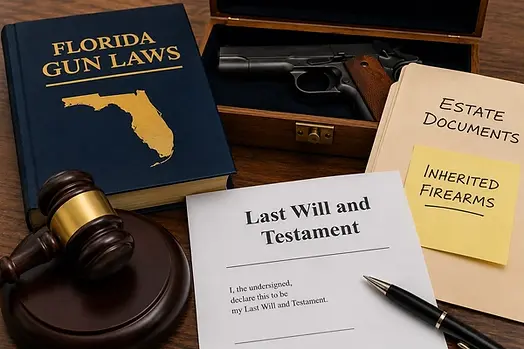
Can a Florida Executor Sell Guns From an Estate?
Often, yes. Firearms are generally personal property, and Florida law authorizes a personal representative, acting reasonably for the benefit of interested persons, to sell personal property belonging to the estate unless the will, a court order, or another legal restriction provides otherwise.
The Personal Representative Must Have Legal Authority
A family member does not become authorized to sell estate firearms simply because they have possession of the guns or are named in the will. The person acting for the estate should first confirm that they have been properly appointed or otherwise have legal authority to administer the property. For the broader rules surrounding inherited firearms, heirs, and estate administration, see the Florida Inherited Gun Laws & Estate Guide.
The Will or Court Order Can Affect the Sale
The personal representative’s statutory powers are subject to the decedent’s will and applicable court orders. If the will specifically directs that certain firearms be distributed to a beneficiary, restricts a sale, or creates another condition, those instructions may affect what the representative can do.
The Executor Must Act for the Benefit of the Estate
A personal representative is a fiduciary. Decisions involving estate firearms should therefore be made for legitimate estate purposes, such as paying expenses, preserving value, resolving distributions, or converting property to cash for beneficiaries.
What Documents Should the Executor Review First?
Before selling, consigning, shipping, or distributing firearms, gather the documents that establish both ownership of the firearms and the authority of the person administering the estate.
Letters of Administration
In a Florida probate estate, letters of administration are important evidence that the personal representative has been appointed by the court and is authorized to act for the estate.
Last Will and Testament
Review the will for specific gifts of firearms, restrictions on sale, directions concerning personal property, or instructions affecting particular beneficiaries.
Trust Documents
If a firearm is owned by a trust rather than the probate estate, the trustee’s authority may control instead of the personal representative’s authority. Confirm who actually owns the firearm before proceeding.
Court Orders
Probate orders may limit, expand, or clarify what the personal representative may do with estate property. If the estate is contested or unusual, the representative should review relevant court orders before selling firearms.
Firearm Records
Preserve serial numbers, receipts, registrations, factory boxes, appraisals, NFA paperwork, and other records that help establish ownership, legal status, and value.
When Should Estate Firearms Be Sold Instead of Distributed?
Not every estate needs to sell its firearms. Some collections are distributed to beneficiaries, while others are sold because the estate needs cash, beneficiaries prefer proceeds, or the collection cannot be divided fairly.
When the Estate Needs Liquidity
Firearms may be sold when cash is needed to pay valid estate expenses, taxes, claims, or costs of administration, subject to the estate plan and Florida probate requirements.
When Multiple Beneficiaries Are Involved
Selling may be appropriate when several beneficiaries have an interest in the collection but do not want the firearms divided among them. Converting the collection to cash can sometimes provide a cleaner distribution.
When the Collection Has Significant Market Value
A specialized firearm collection may contain items whose value is not obvious. Before selling individual guns, consider obtaining a professional evaluation so rare, historic, or collectible firearms are not inadvertently undervalued. For professional evaluation and auction options, see Estate Gun Consignment.
When a Beneficiary Is Supposed to Receive a Specific Firearm
If the will specifically leaves a particular firearm to a beneficiary, the executor should not assume it can be sold simply because selling the rest of the collection would be easier. Specific gifts should be reviewed carefully before disposition.
What if the Heirs or Beneficiaries Disagree?
Beneficiary disagreement is one of the clearest reasons to slow down. The personal representative has fiduciary duties to the estate and should avoid informal side deals that could create disputes or allegations of unfair treatment.
A Beneficiary Does Not Automatically Control Estate Property
A beneficiary may ultimately be entitled to receive property or proceeds, but estate assets are generally administered through the personal representative until properly distributed.
Multiple Heirs May Have Different Interests
One heir may want to keep a firearm while another prefers cash. Those competing interests should be handled through the estate process rather than through informal possession or private agreements.
Disputed Ownership Should Be Resolved Before Sale
If someone claims that a firearm was personally gifted before death, belongs to a trust, or was owned jointly, do not assume it belongs to the probate estate. Ownership disputes should be resolved before the firearm is sold.
When Legal Review Is Appropriate
If beneficiaries object to a sale, ownership is disputed, or the executor is concerned about fiduciary duties, a Florida probate attorney should review the situation before the transaction proceeds.
What if an Heir Lives Outside Florida?
An executor’s authority to sell estate property and the firearm-transfer rules are separate questions. Even when the executor has authority to dispose of a firearm, federal law can affect how a firearm is delivered to someone who lives in another state.
Distribution to an Out-of-State Heir
Federal law contains an exception for firearms acquired by lawful bequest or intestate succession. That means a qualifying inheritance can be treated differently from an ordinary interstate sale or gift.
Selling to an Out-of-State Buyer
A sale to an out-of-state buyer is different from distributing a firearm to a lawful heir. Ordinary interstate firearm sales generally must follow the applicable federal FFL transfer process. See Interstate Gun Sales, Transfers & Shipping for the full interstate transfer process.
Do Not Confuse Inheritance With a Later Sale
If an heir lawfully receives a firearm and later sells it to someone in another state, that later transaction is generally governed by the ordinary interstate-transfer rules rather than the inheritance exception.
What if the Estate Includes NFA Firearms?
Suppressors, machine guns, short-barreled rifles, short-barreled shotguns, and other firearms regulated under the National Firearms Act require a separate federal estate-transfer process. For the specialized federal estate-transfer process, see Inheriting NFA Firearms.
Do Not Distribute an NFA Firearm Before Approval
Federal regulations require the executor to submit the appropriate transfer application before an NFA firearm is distributed to a beneficiary. For qualifying estate-to-beneficiary transfers, the executor files ATF Form 5 on behalf of the estate.
The Executor Acts for the Estate
ATF regulations specifically contemplate the executor, administrator, or personal representative signing the transfer application on behalf of the decedent’s estate.
Missing NFA Paperwork Requires Extra Caution
If a suspected NFA firearm is found without registration paperwork, do not sell, distribute, or surrender it casually. Its registration and lawful transfer path should be reviewed before any disposition occurs.

Ready to Sell an Estate Gun Collection?
Once the executor’s authority and the estate’s ownership are clear, Gun Auctions USA can help evaluate and professionally sell individual firearms or complete estate collections. Learn About Estate Gun Consignment
or call 727-392-3950
Recommended Checklist Before Selling Estate Firearms
1. Confirm Your Authority
Verify that you are the legally authorized personal representative, executor, trustee, or other person permitted to act for the property.
2. Review the Will, Trust, and Court Documents
Look for specific gifts, restrictions, beneficiary rights, or court orders that may affect the collection.
3. Inventory the Firearms
Record make, model, caliber or gauge, serial number, condition, accessories, and any documentation associated with each firearm.
4. Identify Special or Regulated Items
Separate suspected NFA firearms or other unusual items so they are not accidentally treated like ordinary firearms.
5. Determine the Correct Sale or Transfer Path
Decide whether each firearm will be distributed to a beneficiary, sold locally, consigned to auction, or transferred through an FFL. If the transaction will involve an FFL, review Florida Gun Transfer Background Checks.
6. Keep Complete Records
Preserve estate authority documents, sale agreements, transfer records, settlement statements, and documentation showing what happened to each firearm.